Reviewing the Christmas Wreath 3D SVG for Holiday Crafts
As a designer who spends half the year preparing for the holiday rush, I am always cautious about new assets. We all know the temptation of downloading a trendy digital embroidery file only to find it lacks the structural integrity needed for a professional finished product. Recently, I evaluated the Christmas Wreath 3D SVG Multilayer Files with a specific goal in mind: determining its viability not just as a laser-cut template, but as a reference for high-quality machine embroidery design work. While the product is technically categorized under Laser Cutting and Winter Christmas decor, its geometric precision offers valuable insights for those of us stitching custom apparel and home goods.
First Impressions and Visual Personality
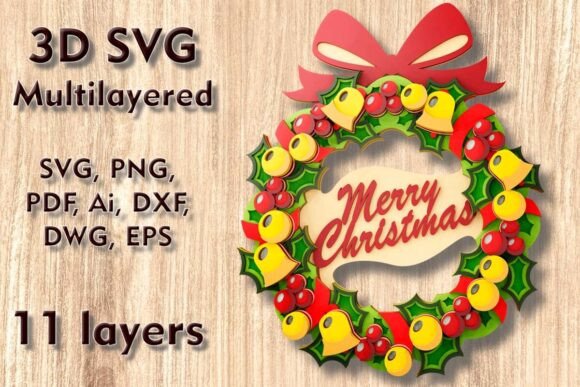
The first thing that strikes you about this design is its architectural clarity. With dimensions of 300 mm height by 245 mm width (approximately 11.8 x 9.7 inches), it commands presence. The "3D" aspect in the title refers to the layered visual effect created by the multilayer structure, which translates beautifully into depth when interpreted through thread. For an embroidery designer, this means the layout has inherent dimensionality. It does not look flat. The mood is festive yet modern, avoiding the cluttered aesthetic of traditional holiday clip art. This visual personality fits seamlessly into boutique branding where customers expect sophistication alongside seasonal cheer.
Real-World Application: The Custom Tote Bag Scenario
To test the practical value, I imagined a common craft business scenario: creating a limited run of heavy-canvas tote bag designs for a local holiday market. The wreath’s circular symmetry makes it ideal for center-placement on a bag. However, because this is a single-layer file with intricate cutouts, translating it to embroidery requires careful planning. If I were digitizing this from scratch or using it as a strict guide, I would need to consider how the negative space interacts with the fabric texture.
In this real-life case, the design would work exceptionally well as an applique design. By cutting the wreath shape from felt or leather and stitching it down with a tight satin stitch border, you preserve the crisp lines that might otherwise get lost in dense fill stitch areas. This approach reduces stitch density, preventing the fabric from puckering, which is crucial for unstructured bags. Customers reacting to such a personalized gift would likely appreciate the tactile quality of the applique, perceiving higher value than a standard stitched image.
Navigating Technical Constraints
While the design is robust, there are critical considerations for embroidery project success. The product description notes that the size is easily increased, but warns against reducing it due to thin elements. This is vital advice. If you attempt to shrink this below 6 inches for a baby embroidery project on a onesie, the fine details may merge, causing thread breaks or an indistinct blob of color. Always check the smallest elements against your needle size and thread weight.
Furthermore, since this is a multilayer SVG intended for physical layering, using it directly for embroidery without digitizing adjustments can be risky. You must verify if your software can interpret the layers as separate color stops or if you need to manually assign them. For sweatshirt embroidery, where the fabric is thick and plush, a running stitch underlay is non-negotiable to anchor the design. Without proper stabilization, the weight of the thread could distort the knit fabric, ruining the custom apparel look.
Material and Surface Considerations
Not every surface is suitable for this level of detail. On stretchy fabrics like jersey caps, the rigid geometry of the wreath might warp during wear. I would recommend using a cut-away stabilizer for any curved surfaces to maintain shape integrity. For dark fabrics, ensure your thread colors have sufficient contrast. A deep green on navy blue might vanish, whereas a metallic gold or bright red would pop, enhancing the holiday embroidery appeal. Testing on scrap fabric is essential to confirm that the hoop size you select can accommodate the full 11.8-inch height without re-hooping, which often leads to alignment errors.
Commercial Viability and Brand Consistency
For Etsy sellers and small shop owners, consistency is key to building trust. This design offers a cohesive look that can be adapted across various products, from embroidered patches to pillow covers. Its clean lines allow for easy integration into printable mockup previews, helping customers visualize the final item. When used in commercial embroidery, the professional finish contributes to brand recognition. Buyers engage more with products that look deliberate and well-crafted rather than hastily assembled.
However, before listing items, you must confirm licensing. Since this is sold as a laser-cut file, using it for embroidered goods may fall under a different usage right depending on the creator’s terms. Never assume a digital asset is free for commercial resale in physical form without explicit permission. Check whether the license covers design assets used in manufactured goods.
Practical Designer Notes
- Test Stitch First: Always run a test on similar fabric weight to check for puckering or thread breaks.
- Contrast Check: View the design in black and white to ensure the layers remain distinct without color reliance.
- Stabilizer Selection: Use tear-away for stable woven fabrics like cotton towels, and cut-away for knits like sweatshirts.
- Scale Carefully: Do not reduce the design below the recommended minimums to preserve the integrity of thin elements.
- License Verification: Confirm if the purchase includes rights for commercial embroidery sales or if it is strictly for personal use.
In conclusion, the Christmas Wreath 3D SVG Multilayer Files is a versatile asset that bridges the gap between laser cutting and embroidery inspiration. While it requires thoughtful adaptation for stitching, its structural elegance and festive charm make it a strong candidate for high-end handmade product lines. By respecting its technical limits and leveraging its visual strengths, designers can create standout small shop products that resonate with holiday shoppers seeking quality and style.