Snowman 3D SVG for Laser Cutting Winter Christmas
As a graphic designer who has spent years refining brand identities and preparing files for production, I approach every new graphic design asset with a critical eye. It is not enough for an illustration to look cute; it must perform under the pressure of real-world application. Recently, I evaluated the Snowman 3D SVG Multilayer Laser Cut File for a potential client project involving a boutique handmade goods store. My goal was to determine if this digital product could elevate their seasonal marketing visuals while remaining practical for physical production.
First Impressions and Visual Mood
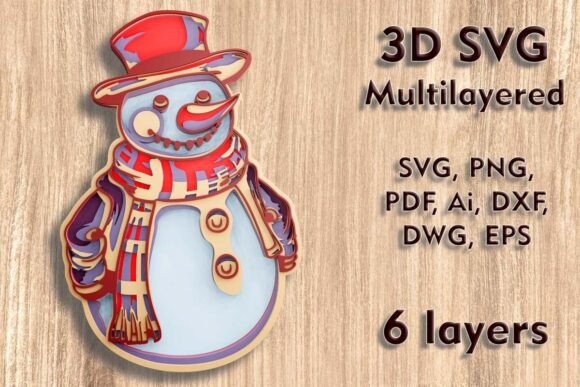
The initial view of this asset reveals a sophisticated approach to layered depth. Unlike flat clipart that often feels disposable, this SVG design offers structural integrity. The mood it creates is distinctly cozy yet modern, fitting perfectly into the Winter Christmas aesthetic without relying on clichéd, cluttered ornamentation. For a client aiming to project warmth and craftsmanship, this illustration serves as a strong anchor. It represents a style that balances playful charm with geometric precision, making it suitable for both high-end packaging and approachable social media graphics.
When considering brand identity, the clean lines suggest professionalism. This is not merely a holiday decoration; it is a versatile component for small business branding. Whether used in a Canva template for Instagram posts or as the centerpiece of a product mockup, the asset maintains its visual weight. It appeals to audiences looking for quality, which is essential for any handmade business trying to distinguish itself in a crowded creative marketplace.
Performance in Real Design Scenarios
In my review, I tested how this file adapts across various mediums. For packaging design, the multilayer structure allows for tactile engagement. Imagine this design cut from premium cardstock and adhered to a gift box lid. The six distinct layers create shadow and depth, turning a simple package into a memorable unboxing experience. This level of detail supports commercial design standards where perceived value is crucial.
For digital applications, such as web design or editorial design, the scalability of the vector format is a significant advantage. I placed the asset alongside various typography styles to check compatibility. It pairs surprisingly well with elegant serif fonts for a traditional look, but also holds its own against bold sans serif fonts for a contemporary feel. However, it may clash with overly ornate script fonts, where visual hierarchy could become confused. For marketing visuals like flyers or posters, the design acts as an excellent hero graphic, drawing the eye immediately without overwhelming the textual information.
Crafters and Cricut users will appreciate the precision required for Laser Cutting. The file is optimized for machines that handle multiple passes or layered materials. For those in the print-on-demand sector, this asset can be adapted for sublimation design on mugs or tote bags, provided the layers are flattened or color-coded correctly for single-pass printing. It also serves as a robust base for sticker design, where die-cut lines can follow the outer contour for a premium finish.
Strategic Placement and Limitations
Understanding where to place this asset is key to successful implementation. It works best in large layout areas where its dimensional qualities can shine. Use it as a focal point in social media graphics or as a decorative accent on printable wall art. In logo design, it might serve as a seasonal variant rather than a permanent mark, ensuring brand consistency while allowing for festive flexibility.
However, designers must exercise caution. The Snowman 3D SVG Multilayer Laser Cut File has specific constraints. The original dimensions are approximately 195mm wide by 290mm high. While the size is easily increased for large banners or signage, reducing the design requires careful attention. Thin elements within the six layers may become fragile or disappear entirely if scaled down too aggressively. Avoid using this asset in crowded layouts or on complex backgrounds where contrast is low. It is not suitable for minimalist corporate materials that demand stark simplicity, nor should it be used in small sizes where the intricate layering becomes visual noise rather than detail.
Practical Designer Notes for Client Projects
Before delivering this asset to a client or using it in a commercial project, I recommend several technical checks. First, test the design in black and white. This ensures that the silhouette remains recognizable even without color differentiation, which is vital for t-shirt design or single-color prints. Check contrast on both light and dark backgrounds to verify visibility. If the file includes PNG versions, inspect the transparency edges for artifacts. For the SVG version, open it in your preferred vector editor to confirm that all paths are closed and nodes are clean.
Consider the materials specified for Laser Cutting. Different woods, acrylics, or papers will react differently to the layer thickness. Always request a test cut to ensure the thin elements hold up during handling. Review the commercial license thoroughly. While many assets in the design bundle category allow for commercial use, confirming the terms protects both you and your client from legal issues. This is particularly important for Etsy product sellers who rely on clear intellectual property rights.
Finally, think about the emotional appeal. Does this illustration align with the client’s voice? For a brand focused on family, tradition, and warmth, this snowman is an ideal choice. It enhances visual trust by showing attention to detail. For a tech-focused or ultra-modern brand, it might feel out of place. Always preview the asset in context, placing it on real mockups to gauge its impact on the overall impression of the design project.
In conclusion, the Snowman 3D SVG Multilayer Laser Cut File is a powerful tool for designers who understand the nuances of layered composition. It bridges the gap between digital convenience and physical craftsmanship. When used thoughtfully, it elevates brand identity, engages audiences through tactile and visual appeal, and supports a wide range of creative design applications. By respecting its limitations and leveraging its strengths, you can create polished, professional results that stand out in the competitive landscape of seasonal design.